
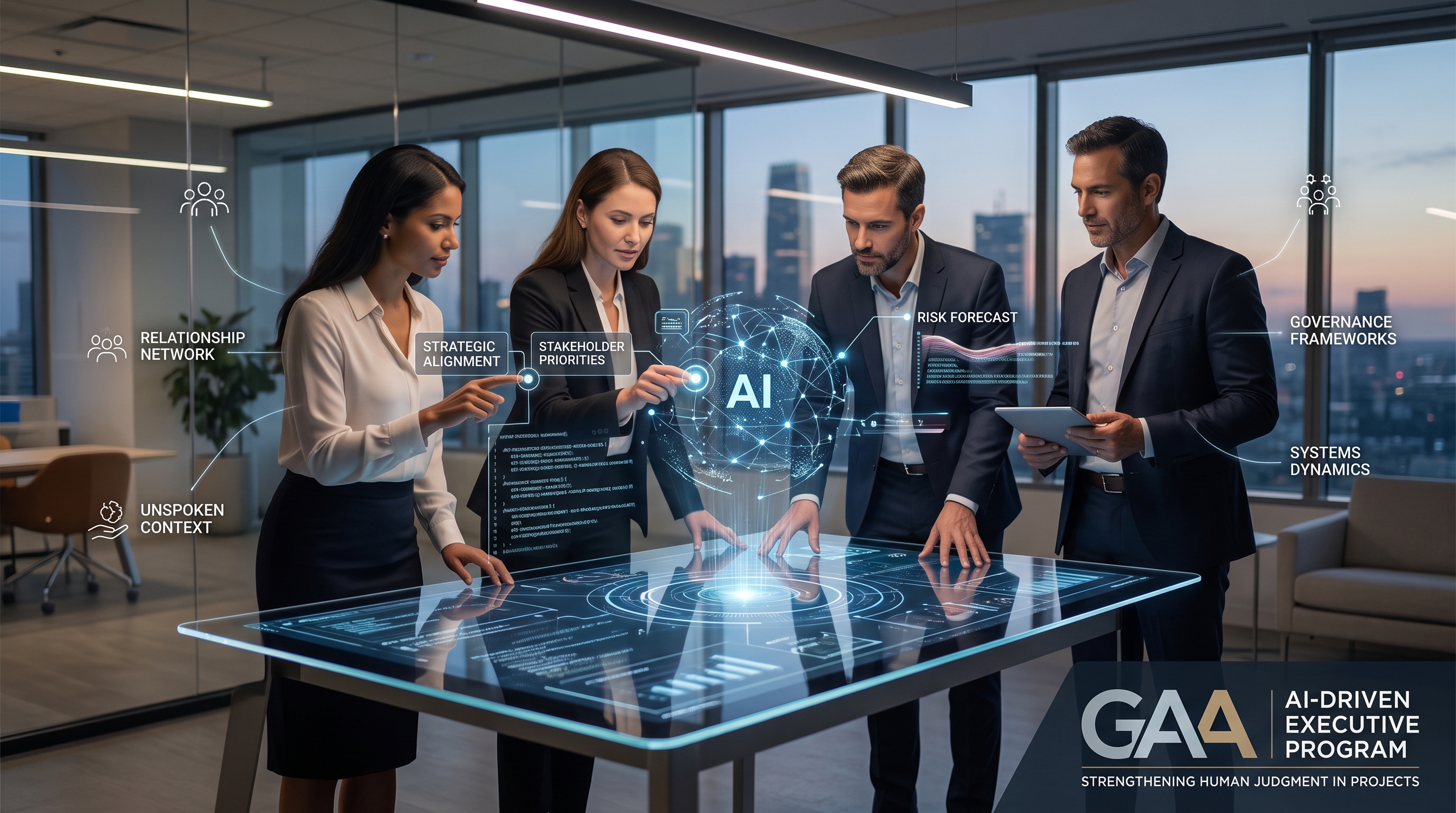
Artificial intelligence is fundamentally accelerating how organizations execute initiatives. However, the ultimate value of these technology-driven projects hinges on a distinctly human capability: the quality of our judgment. Speed alone guarantees very little if it drives us faster toward the wrong outcomes.
AI generates outputs based strictly on the digital data it can process. Yet, in modern project environments, the most critical context is often invisible to algorithms. Unspoken stakeholder priorities, shifting regulatory moods, and fragile cross-functional alliances are rarely captured in a database. Leaders surface this nuanced context through daily interactions, political awareness, and relationship-building. It is human judgment that transforms an AI-generated suggestion into a viable, actionable strategy.
As business environments grow increasingly interconnected, leading complex projects requires a new tier of strategic capability—a need frequently highlighted by participants in the AI-Driven Executive Program by GAA, where the focus is on marrying technological leverage with advanced executive insight.
To successfully navigate this landscape, leaders can apply five practical strategies to fortify human judgment when working with AI outputs.
1. Cultivate Discernment in an Information-Rich Era
Historically, the primary bottleneck in decision-making was a lack of information. Today, data is instantaneous and limitless. What has become exceptionally rare is practical wisdom—the ability to determine which data points actually matter and warrant action.
AI effortlessly generates immense volumes of analysis on demand. Consequently, the leader’s role shifts from gathering information to filtering it. Executives must help their teams distinguish critical signals from background noise, evaluate the credibility of AI models, and translate raw analysis into cohesive action plans.
Application: Treat AI outputs as a single variable in a broader equation. Before acting, teams should ask:
What underlying assumptions is this model relying on?
Whose organizational perspective is missing from this analysis?
What are the cascading consequences of acting on this recommendation versus ignoring it?
2. Evaluate AI Outputs Through a Systems Lens
Modern project managers are no longer just delivering scopes of work; they are orchestrating continuous organizational change. Initiatives exist within complex, interdependent ecosystems shaped by economic, technological, and cultural shifts. Complexity is no longer a unique challenge—it is the baseline.
Professionals who thrive in this environment utilize systems thinking. They view projects not as isolated checklists, but as webs of dependencies. Developing this exact capability is a core pillar of the AI-Driven Executive Program by GAA, which trains leaders to act as sensemakers and value stewards across fragmented stakeholder groups.
Application: Stress-test AI recommendations at the macro level before implementation.
Which adjacent teams or legacy systems will this decision disrupt?
Could solving a problem in our department create a bottleneck in another?
How adaptable is this approach if market conditions suddenly shift?
3. Bridge the Gap with Unspoken Organizational Context
For decades, the most complex project decisions have relied heavily on tacit knowledge—the undocumented wisdom living inside the heads of experienced leaders. Because human beings are adaptable and context-aware, this informal system works surprisingly well.
Seasoned executives instinctively know which vice president to consult before drafting a proposal, which risks require immediate escalation, and which process bottlenecks can be safely bypassed. AI cannot replicate this political and relational intuition. When organizations attempt to automate executive decision-making, they often find that algorithms expose the inconsistencies in human judgment but fail to provide the nuanced context needed to resolve them.
Application: When an AI recommendation feels disconnected from reality, identify the human experience it is missing.
What informal relationships will dictate how this strategy is actually received?
What unspoken criteria are stakeholders using to evaluate success?
Where does strict standardization help, and where does it suffocate necessary leadership intuition?
4. Leverage AI as a Devil’s Advocate
Because AI operates quickly but lacks full organizational awareness, its most powerful application is not as a final decision-maker, but as a relentless critical thinking partner.
Instead of asking AI to validate your strategy, use it to attack your team’s preferred position. Task the model with finding holes in your business case, surfacing overlooked vulnerabilities, predicting stakeholder objections, and generating completely contrary interpretations of your foundational data.
Application: Hardwire "challenge prompts" into your project workflows.
What would have to be true for our preferred strategy to fail?
What data would completely disprove our current assumptions?
Under what specific market conditions would an alternative approach outperform ours?
5. Establish Clear Guardrails and Accountability
Before deploying AI deeper into project workflows, organizations must establish robust governance. This should not be a vague, company-wide manifesto, but rather specific rules of engagement at the workflow and decision level.
Effective governance separates technology adoption from true business value. The ultimate metric of success is not how frequently a team uses generative tools, but whether those tools measurably improve decision speed, risk mitigation, and stakeholder satisfaction.
Application: Define explicit decision rights for human-AI collaboration.
In what specific scenarios is AI permitted to act autonomously?
At what exact thresholds must a human leader intervene?
Who ultimately owns the consequences if the AI output is flawed?
How will the team measure whether the AI actually improved the baseline outcome?
The organizations that will dominate the next decade are those that seamlessly pair high-speed technological capabilities with elite business acumen. Technology can dramatically accelerate the formulation of a decision, but accountability always remains with the people. As AI becomes deeply embedded in our daily operations, the uniquely human ability to integrate context, build trust, and take ownership will become the most valuable asset an executive can possess.
Frequently Asked Questions on AI and Executive Decision-Making
How should leaders integrate AI into complex project decisions? AI should function as a powerful analytical input, not a definitive authority. Leaders add value by taking AI-generated insights and filtering them through the realities of organizational politics, stakeholder dynamics, and overarching business strategy before pulling the trigger.
What must be verified before acting on an AI recommendation? Always audit the assumptions driving the output. Identify what contextual data the model lacks, and evaluate how the proposed action will ripple across other departments. Furthermore, use AI to challenge your own biases by asking it to generate alternative scenarios and highlight hidden risks.
Who holds accountability for AI-assisted business outcomes? Human leaders retain absolute accountability. It is vital to establish clear governance that dictates when an AI system can operate independently, when human oversight is mandatory, and who holds the final override authority.