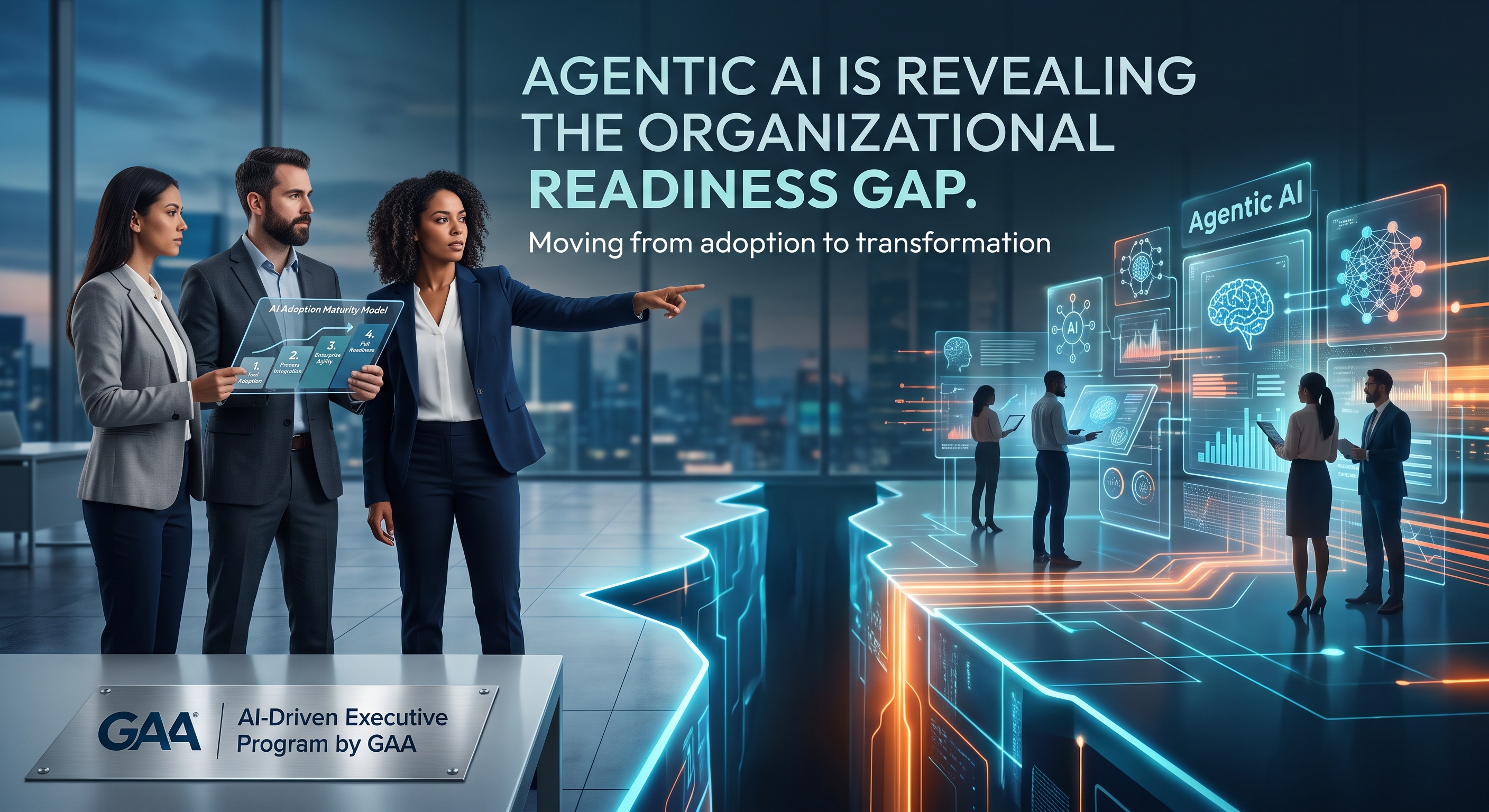
The real question for leaders today isn’t if they will adopt AI, but whether their organization is truly equipped to evolve alongside it.
The conversation around AI is shifting. For years, the focus has been purely on implementation: selecting the right tools, finding quick wins, and rolling out new technology. But as agentic AI begins to actively reshape how work gets done, a new challenge is surfacing: organizational readiness.
Recent research from Deloitte highlights this growing gap. While nearly two-thirds of executives report reevaluating their business models due to agentic AI—and 75% recognize that human-AI collaboration yields more value than mere automation—half admit they are underinvesting in the necessary workforce transformation.
The takeaway is stark: the primary hurdle for AI is no longer technical. It’s human.
The True Transformation Extends Beyond Tech
Many companies still treat AI as a standard IT rollout—deploying software, automating specific tasks, and banking on immediate productivity bumps. Agentic AI demands more.
Realizing the full potential of these advanced systems requires a fundamental rethink of workflows, operating models, and the collaboration between humans and machines. Deloitte’s data reveals that only 5% of organizations feel highly prepared for AI agents, and a mere 15% have managed to scale adoption across different functions.
This disparity between ambition and execution should be a wake-up call. You can install technology overnight, but transforming an organization takes deliberate capability building.
Agility is the New Operating Standard
As AI continues to disrupt traditional business models, organizations must shift from periodic, reactive changes to a state of continuous adaptation. Enterprise agility is the key differentiator here.
Agile organizations are built to redirect resources swiftly, empower decision-making closer to the front lines, and adjust their operating models as conditions dictate. Crucially, they can translate high-level strategy into on-the-ground execution while keeping teams aligned.
The goal isn't necessarily to predict exactly what AI will look like in three years—it’s to build an organization capable of pivoting no matter what shape it takes.
The Workforce Must Keep Pace
One of the most striking findings from the Deloitte study is the disconnect between expected disruption and actual investment. Leaders anticipate that agentic AI will significantly disrupt the workforce, yet many acknowledge they aren't spending enough on workforce transformation.
This is a classic pitfall. Organizations pour resources into technology while neglecting the people, leadership skills, and change management required to make it stick. AI adoption is, fundamentally, a human endeavor. Success relies on leaders who can navigate change, teams that can integrate AI into their daily routines, and governance frameworks that maintain clear accountability as intelligent systems take on more autonomy.
Navigating the Readiness Gap
The companies that will ultimately win with AI aren’t necessarily the ones with the most advanced tech stack. They are the ones capable of executing continuous change.
This requires a strategic commitment to redesigning work, upskilling talent, and establishing agile governance. To help leaders bridge this gap and cultivate these critical capabilities, the AI-Driven Executive Program by GAA provides the frameworks and strategic foresight needed to align your workforce and operating model with the realities of agentic AI.
The future belongs to those who don’t just implement AI, but who are prepared to evolve with it. The defining question for leadership is no longer, "How do we deploy this tool?"
It’s, "Are we ready to transform?"